Steven Soderbergh\’s \’Presence\’ Opens Strong, Nearly Doubling Its Budget in First Weekend

The latest from director Steven Soderbergh opened strong this past weekend, nearly doubling its modest $2 million budget. In total, the film grossed $3.7 million in its first three days of wide release. We reviewed the film last week, and gave it a positive rating thanks especially to the strong direction and camerawork from Soderbergh. While Flight Risk (starring Mark Wahlberg and directed by Mel Gibson) was the biggest winner at the box office with $12 million, the budget of that film was $25 million. At Screen Love Affair, we think it\’s important to celebrate film whenever we can. While others will try to frame Presence as a box office flop, this is an undeniable win for a relatively low budget movie. As a regular theatergoer, I follow Dan Murrell’s weekly Charts With Dan, not out of an obsession with corporate profits, but to understand how these figures shape the kinds of movies we get to see. While the fixation on box office performance often feels reductive, by reducing art to dollar signs, it’s impossible to ignore its impact on what gets greenlit. As fans of movies though, our focus should be on the stories and craftsmanship, not the dollar signs. Films like Presence prove that there’s still an audience for unique projects that can both enrich the cinematic landscape and still turn a profit. Not every film needs to rake in hundreds of millions, nor should every project require blockbuster budgets. There’s enough to lament about the state of cinema and the theatrical experience, so let’s celebrate the presence of every box office victory, no matter how small they may seem.

Steven Soderbergh\’s \’Presence\’ Opens Strong, Nearly Doubling Its Budget in First Weekend Read More »

Quiet, Please! The Fight to Save Movie Theatre Etiquette

If you’re a movie lover on social media, you’ve probably noticed an unsettling trend: audiences treating theatres like their personal living rooms. The release of Wicked seems to have amplified this, with a viral post of someone snapping a photo of the title card and encouraging others to do it, and other people even singing along during the film. At the same time all this was happening during Wicked, I was watching fight scenes in the coliseum during Gladiator II while someone played Candy Crush on their phone a few rows down from me.  If that’s not bad enough, celebrities like Cynthia Erivo and Dwayne “The Rock” Johnson have encouraged disruptive behaviour during movies, blurring the lines of what’s acceptable at the theatre. It feels like people no longer know how to behave in crowds, and this problem is particularly pronounced in movie theatres. While Broadway offers sing-along performances to cater to audience participation, they also set clear boundaries for regular showings. Similarly, some movie theatres have hosted designated sing-along screenings, yet disruptions still occur during non-sing-along showings. So why does this happen when we’re simply trying to enjoy a movie on the big screen? Before we get into this more deeply, I’m going to state my bias up front. I speak for everyone at Screen Love Affair when I say that we firmly believe that using your phone or talking (let alone singing) in the theatre is completely unacceptable.  Watching a movie in a theatre is a communal experience, shared by every person in the theatre watching the movie with you. The moment you start using your phone or talking loudly during a movie, you’re negatively impacting every other person in the theatre with you. Whether it’s having to listen to somebody’s conversation drown out the audio from the movie or being distracted by the bright light of a phone that even people in the back row can see, these distractions make it hard to focus on the reason we’re here in the first place: to watch a movie on the big screen, in a dark room, and free from the distractions of the outside world. Because going to the movies is a communal experience, we have to have a mutual respect for each other, and what I’ve seen lately on social media demonstrates that that respect is nowhere to be found.  When Did Theatre Etiquette Go Off Script? Theatre etiquette issues are nothing new. As long as movie theatres have existed, people have been talking in them. But things weren’t always this bad. Decades ago, watching a movie was akin to attending a live performance. Audiences were expected to sit silently, immersing themselves in the story on screen. Whispering was frowned upon, and the thought of opening a bag of candy during a quiet scene—risking even the slightest noise—was almost unthinkable. I first noticed a major change when I was younger and watched Marvel movies in theatres. These films brought something different to theatres, offering a new kind of experience on the big screen. Martin Scorsese famously likened superhero movies to “theme park rides,” and it’s easy to see why. Attending a Marvel movie during opening weekend can feel like a communal celebration as fans show up in costumes, cheer, and even scream at pivotal moments. These movies are designed to amplify that energy, with perfectly timed applause breaks built in for those “epic” scenes. It’s almost impossible not to get caught up in the enthusiasm during a screening like that. Anyone who grew up with these films will remember how electric the opening weekend of Avengers: Endgame was, and the sheer excitement it inspired. Beyond Marvel, concert movies have also blown up more recently, with Taylor Swift and Beyoncé being two of the biggest examples that come to mind. These things existing aren\’t the problem, but it demonstrates that, like everything over time, the theatre-going experience is changing.  The real issue is that we’ve had a generation of moviegoers that have grown up with these kinds of movies and think this is the way that all movies are meant to be experienced. After all, if people are screaming and cheering the whole time, what’s a quick glance at your phone or chat with your friend?  These days, bad theatre etiquette is rampant and inescapable, even when you’re watching a more traditional kind of film. For example, I went to see Gladiator II in IMAX recently with some friends and it was an incredibly frustrating experience. Seated behind us were a group of friends that were leaning over each other and talking loudly and consistently throughout the movie. If that wasn’t bad enough, someone near the front of the theatre pulled their phone out regularly with the brightness incredibly high to play games on their phone. Someone else was constantly pulling their phone out to seemingly check the time, while another person near the front was recording certain moments of the movie.  What can we do in situations like this? Well I turned around to politely request the people behind us not talk during the movie. I had to turn around two more times (growing less polite with each turn) until they finally stopped. But there was nothing I could do about the phones. I was seated too far away to say anything without disrupting other people. To do anything, I would have had to move past 20 other people on either side of me as I was seated in the middle of a row, and then walk around talking to each individual person, or leave to go get a theatre employee. Is it fair to me or any other paying customer to have to do that, though? Absolutely not.  It’s not just one bad experience, either. I constantly see phones at nearly every movie I watch in theatres, hear people talking as if they’re the only ones there, and I even sat near more than one person who actually answered a phone call in the middle

Quiet, Please! The Fight to Save Movie Theatre Etiquette Read More »

Twisters Turned Me Into a 4DX Believer (Sort Of)

If you’ve read Shea’s roundup of Dune: Part Two in every format, you might have gathered that we’re not the biggest proponents of the more gimmicky formats offered by theatres these days over here at Screen Love Affair. Personally, I find most of them to be unnecessary and distracting. I actively dislike gimmicks like 3D, no matter how hard James Cameron tries to sell me on it, and DBox, which I found mildly amusing but highly distracting. These gimmicks tend to have the opposite of their intended effect and break my immersion, rather than add to it. A good movie, I believe, doesn’t need any extra effects to be transportive and fun. It just needs to tell a compelling story. I\’ll admit, the first and only time I’ve seen a movie in 4DX was when we saw Dune Two. The novelty of the experience was fun at first, but it quickly wore out its welcome and made me wish I had just gone to see the movie in IMAX again. It was amusing, and I didn\’t regret trying it out, but I didn’t feel the need to ever try it again. Ultimately, it was just too distracting for me to really justify the cost of admission (especially when the theatre-going experience today is already so expensive, among other things). But Lee Isaac Chung\’s Twisters (2024) may have converted me. 4DX is the most maximalist of movie gimmicks. Here, have a little bit of everything, it says, practically turning a trip to the movie theatre into an amusement park ride. Twisters, however, is the perfect 4DX movie—it feels almost as if the 4DX experience was invented for it. I realize now how mismatched Dune: Part Two was to what 4DX promises. Yes, there\’s action in Dune, but most of the 4DX tricks felt superfluous to it and didn’t add anything except an amusing distraction from what was happening on screen. But with Twisters, the 4DX effects felt perfectly suited to what was happening on screen. Every time the wind machines picked up or I felt droplets of mist on my face, while faced with the gusts of wind and rain unfolding on the screen, it felt as if the fourth wall was breaking, and I could pretend just a little bit that I was in the movie. While the strobe lights were one of my least favourite effects during Dune—flashing during sequences of artillery fire in a way that felt out of place and irritating—here, the strobes were used sparingly but to fantastic effect, flashing in time with the occasional lightning strike on screen to make me feel as if I was watching a real, live thunderstorm. The fact that there was a real, live thunderstorm happening outside the Cineplex at the time of my screening (and, in fact, a tornado touched down in nearby Perth, ON that same night) was just icing on the immersive experience cake. The opening sequence of Twisters is a particularly fun, and surprisingly brutal, way to throw us right into the action. As the devastating EF 5 tornado built up, and the storm grew more intense, and the 4DX chairs started to move and rumble, and the wind machines picked up, and drops of water started hitting my face, I couldn’t help but feel giddy. I had already seen Twisters in IMAX before seeing it in 4DX, and I felt pretty giddy then too, but mostly due to the thrill of having a fun time at the movies with a whole bunch of my friends. But at 4DX, it was the same sort of giddiness you might feel on the upward slope of a rollercoaster. When the action in that opening sequence builds up to its most intense moment, holding on Daisy Edgar Jones\’s Kate as the storm gusts around her, sound building to the point of being almost unbearable, and then the wave of tension finally breaks and the sound cuts out—and all of the 4DX hustle and bustle stops with it—the entire theatre let out a collective chuckle of nervous laughter and relief. That has got to be one of my favourite movie theatre moments so far this year, because it reminded me of why I love going to the movies in the first place, of how, throughout the whole history of cinema, going to the theatre was always a communal experience. In that moment, we were all feeling the same thing at the same time. The joy and excitement at what we were collectively getting into was palpable, and I felt a little more connected to everyone in the room because of it. It sounds a little silly to say I had a profound moment of shared humanity during a big, dumb blockbuster disaster movie about people trying to tame tornadoes. But Twisters is also deceptively deep. Chung’s feature debut, Minari, was a beautifully small-scale story about a family of immigrants trying to make the American Dream a reality. Twisters, on the other hand, is big in every sense of the word, but it, too, is concerned with the ways that people come together and help one another survive. The answer lies in collective action and care. We have to take care of each other, and the only way to tame a tornado is together—with a rag-tag group of storm chasers, led by Glen Powell. I keep coming back to a sequence around the middle of the movie, in which Glen Powell’s Tyler Owens and Daisy Edgar Jones’s Kate Carter are intercut, explaining the science and mystery of tornadoes—how we don’t actually know precisely what makes them form. There’s an element of unknowability and unpredictability in these major natural phenomena that have the power to both shape and destroy our world as we know it. We can’t really know what goes on inside a tornado, and yet we keep trying to figure it out anyway. Maybe it\’s cheesy, but I find that kind of beautiful. What I\’m really trying to get

Twisters Turned Me Into a 4DX Believer (Sort Of) Read More »

SLA at Fantasia: Conversations with the Stars and Director of Witchboard (2024)

I\’m thrilled to bring you the first set of interviews we\’ve ever done here at Screen Love Affair! These interviews were conducted on the red carpet ahead of the world premiere of Witchboard as part of our coverage of the Fantasia Film Festival. Be sure to also check out our spoiler-free review of Witchboard! Our first interview is with writer/director Chuck Rusell! His credits include Nightmare on Elm Street 3: Dream Warriors, The Blob (1988), The Mask with Jim Carrey, The Scorpion King with Dwayne “The Rock” Johnson, and Eraser with Arnold Schwarzenegger. We were also able to chat with two of the stars of Witchboard, Madison Iseman (Jumaniji franchise, Annabelle Comes Home) and Charlie Tahan (I Am Legend, Ozark)! Before we jump into the interviews though, I just want to take a second to shout out Josh Korngut from Dread Central! This was my first ever red carpet and my first time having the chance to do interviews with the cast and crew of a movie. So, to say I was nervous would be an understatement, but Josh immediately put me at ease and was very supportive throughout the whole experience! We spent our time together talking about everything horror and as a self-titled horror veteran, I thought Josh had some amazing insights to share. I definitely suggest you check out Josh\’s work over at Dread Central and that you listen to his podcast, Development Hell, to satisfy all of your horror movie needs. Now, let\’s start things off with our chat with Chuck Russell! Chuck Russell Shea: You have one of the most diverse and coolest filmographies of any director. It includes Nightmare on Elm Street 3: Dream Warriors, The Blob, The Mask with Jim Carrey, Scorpion King with Dwayne “The Rock” Johnson, and Eraser with Arnold Schwarzenegger.  Chuck: I’ve had my fun! (Laughs) Shea: Yes that’s true! So what is it about horror that seems to draw you back to the genre? Chuck: It is one of the genres where you can be the most imaginative, where you can be the most fearless. You can drag your actors to crazy, crazy places. Literally, it’s the strongest thrill you can deliver to an audience—is a gasp, or a scream, or a scare, and to bring that through that suspense. [It\’s] the catharsis of facing your worst fears, then having a little popcorn and leaving safely.  Shea: I saw an interview you did last year at ComicCon where you said that you felt with Witchboard the same thing you felt about The Blob as far as almost feeling compelled to do a remake with your own spin on it. I’m curious what exactly you meant by that and if you’d care to flesh out that point a little more? Chuck: Let’s call it a re-imagining. I get a big kick out of really resonant pop culture material, that I can actually tell in my own way, personalize it, and kind of explode it. So, everything that they did in the original Witchboard started a subgenre of Ouija board movies, so give them credit, because it’s still some people’s favourite film from the 80’s. But this is ready for re-imagining, and we take it to a new place and do things that audiences have never seen before. So, for me, it was a springboard. We honour the original, but you’ll see where we take it . . . It’s a fun, scary ride!

SLA at Fantasia: Conversations with the Stars and Director of Witchboard (2024) Read More »

20240317 154515 0000

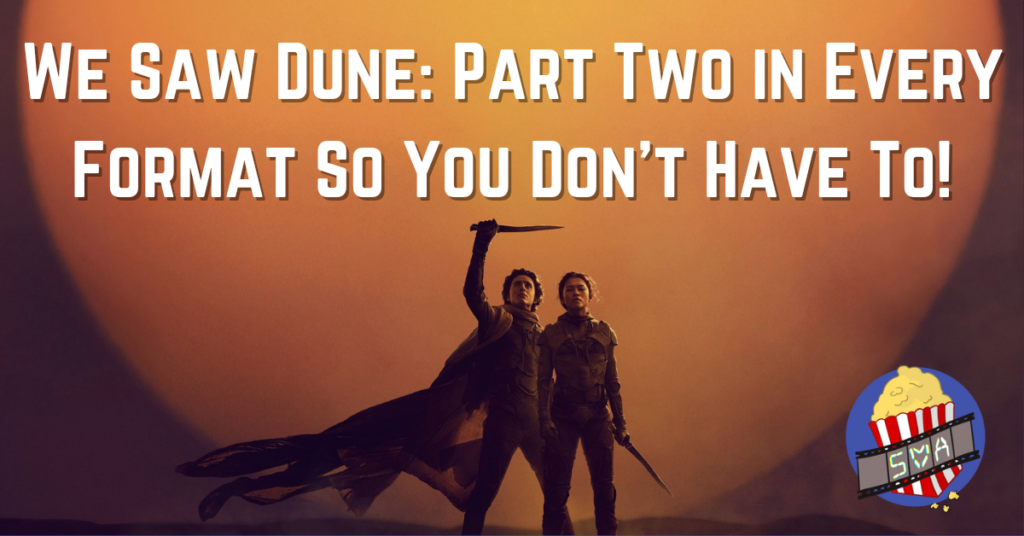
We Saw Dune: Part Two in Every Format So You Don\’t Have To!

If you\’ve just woken up from a coma, you may not be aware that Dune: Part Two is currently out in theatres across the world! I\’ve already published my spoiler free review here on Screen Love Affair. In that review I described Dune: Part Two as a generation-defining film the likes of which I haven\’t seen since The Lord of the Rings trilogy. It\’s a sci-fi epic that must be seen on the biggest screen and with the best sound possible, so you can be transported away to the spice fields of Arrakis and immersed in the world that director Denis Villeneuve brings to life.  After reading such overwhelming praise you\’re probably already grabbing your phone right now to buy tickets. However, you\’re now faced with a choice: What format should I watch this movie in?  Depending on where you live, there can be a lot of choices too. On top of a regular theatre, you also have 3D, D-Box, UltraAVX, ScreenX, 4DX, 70mm, IMAX, or some combination of those formats, and each one of them is advertised as the best way to immerse yourself in the movie.  I\’ve realized that many moviegoers face the same dilemma of choosing the best format for their viewing experience, so in this article, I\’ll give you a comprehensive guide to all of the non-standard formats and give you my personal recommendations! For reference, a ticket to a regular screening of Dune: Part Two is $14.00. All prices are shown in Canadian dollars and don’t include taxes or Cineplex’s predatory “online booking fee”. It does however include the extra $1 that Cineplex charges for popular movies. If you want to read more about my disappointment with Canada’s largest theatre chain over some of these practices, check out that article here. The Formats Ranked #6 – D-Box: $22.00 D-Box is a normal theatre in terms of screen and sound, but some rows in the theatre are special D-Box seats that move and vibrate. These seats can vary in size and looks depending on your theatre, but in Montreal they were just slightly comfier standard seats. Each seat has a settings pad where you can lower or raise the intensity of the experience. The movement isn’t significant even at the highest setting and just more or less can tilt the seat up, down, forward, backwards, and side to side. The movement and vibrations are set for each movie to try and match what’s happening on screen to offer a more “immersive” experience.  Given that this is last on my list though, I can’t say that this makes for a very immersive experience. In fact, I think it actively detracts from the movie.  A certain meme came to mind when reflecting on my D-Box experience: I’m not sure what I can say beyond this is just watching a movie in a vibrating chair that also occasionally tilts. It’s a pure gimmick and is so distracting that if you’re actually trying to watch the movie, you’ll just want to set it to low or move to a different seat. Unlike 4DX, though, which is also incredibly distracting, this doesn’t change the experience enough to justify doing this after you’ve watched the movie in a more ideal format.   Verdict: 💔💔 I can’t recommend D-Box to anyone for any reason and for $8 more than a normal ticket you should just avoid this at all costs.  #5 – ScreenX: $20.00 ScreenX is a unique theatre experience with two additional projections on the sides of the theatre as if it\’s extending the screen. The walls were specifically designed for this projection too, so it’s not just projecting on the walls of a regular theatre. There are two projectors in the middle of the theatre projecting on the opposite walls so the whole theatre is much brighter than a normal screening would be too. I took a picture just before the movie started so you can get a sense of what this looks like: On the experience itself, I\’m more mixed than I expected. Of all these new gimmicky formats, this is the one that has the most potential, I suppose, but also has the worst implementation.  The movie starts with the side screens in full use for the entire opening sequence of the movie and I was very distracted by it. It definitely makes you feel more surrounded, but I caught myself looking at the side screens a few times, and they definitely don’t look great. I’m not sure exactly how they do all of the visuals for the side screens, because the movie certainly wasn’t filmed this wide, but it was clear that they used some very low quality digital effects to try and simulate what would be there. The image quality on the sides is also noticeably lower too, so the image lacks detail and clarity. To make matters worse, the colours on the side screens were noticeably different as well. Shots of the desert in Dune: Part Two are a bit more white than the two side screens, which had a consistent orange tint to them that didn’t match up with the main screen most of the time.  The other issue I noticed right away was that there were noticeable gaps where the edges of the screens meet, which looked incredibly wonky. As people entered the frame on the main screen from one of the sides, there were noticeable misalignments and slight delays that made it feel off. Because the side screens are more squared too, there were issues with shots not being lined up. For example a shot of the planet Arrakis from space very early in the movie doesn’t line up properly so even in my peripheral vision I could see the planet looked jagged in a way it wasn’t supposed to. It\’s not the best example, but you can even notice a similar issue on a picture I took before the movie started: In spite of all of these noticeable issues though, I started to

We Saw Dune: Part Two in Every Format So You Don\’t Have To! Read More »

20240310 231702 0000

Dear Cineplex, It\’s Not Me, It\’s You

Dear Cineplex, I feel it’s only right to start this open letter by expressing my profound love for movies. The website you’re reading this on was something I created to provide a place for my friends and I to write about movies. More than just being a movie lover though, I adore the experience of going to the movie theatre. According to a rough count of my logged movies on Letterboxd, I went to the movie theatre 62 times in 2023. Though 2024 was off to a slow start, I managed to make it to the theatre 15 times so far this year. Theatres offer a unique opportunity for friends and strangers alike to come together for a shared experience unlike any other. Some of the most profound thoughts and feelings I’ve ever had were experienced in a movie theatre.  Like most Canadians, Cineplex theatres are the only places for me to see the latest releases. Whether it was the Galaxy Cinemas in Owen Sound or the Scotiabank Theatres in Ottawa or Montreal, Cineplex theatres are where I’ve always gone to the movies. I’ve been a Scene member for 14 years and a Cineclub member from the very beginning. I give Cineclub memberships to friends as gifts, I bring countless people to the movies every single chance I get, and I often see the same movie multiple times (Top Gun: Maverick & Dune: Part Two will be tied for my personal record of 7 times each in theatres).  Basically, the point I’m making here is that I’m a very loyal customer and I always have been. But you haven’t been making it easy for me, Cineplex.  Movie theatres have been facing challenges from all sides. During the pandemic, theatres were regularly shuttered, with some never reopening again. At the same time, studios leaned heavily into streaming services. Some movies bypass theatres altogether, while others get incredibly short theatrical runs at a handful of theatres, or are released to theatres and streaming platforms at the same time. The competition is fierce and if you track the box office on a weekly basis (or follow someone like Dan Murrell who does it for me) you can see that we’re still struggling to generate box office levels comparable to the pre-pandemic era.  It’s never been more important to entice people to return to theatres. It would be easy to blame everything on companies like Netflix and their efforts to send movie theatres to oblivion as they did Blockbuster, but they aren\’t your biggest problem. You are your biggest problem. You’re doing nothing to encourage people to return to theatres, you do nothing to keep the people that do go to theatres coming back, and to add insult to injury, you nickel and dime moviegoers every chance that you get. Whether it’s your absurd “online booking fees”, your price increases when a movie actually does manage to pull in an audience, or your consistent inability to enforce any sort of rules in your theatres, it’s increasingly difficult to justify going to the movies or convincing others to join me.  I bet that most people that have gone to the movies lately might not even realise they paid extra fees or higher prices. If they buy a ticket online or through the Cineplex app, they are charged an extra $1.50 per ticket. That new fee alone has gouged an additional $40 million for Cineplex from the moviegoers that still support your business. Cineplex is currently being sued over this in a class action lawsuit and by the Competition Bureau of Canada, by the way. Also, you know all those people that went to see Barbie or Oppenheimer last year? Or the ones that have seen Dune: Part Two recently? Well they might not be aware that they also spent an extra $1 per ticket because you jacked the prices up for popular movies. That’s right! The Globe and Mail’s Film Editor and Chief Film Writer, Barry Hertz, brought attention to this recently with the premier of Dune: Part Two. For the record, Canada’s second largest theatre chain, Landmark Cinemas, is also guilty of this one.  But for the sake of argument, let’s say we still make it to the movie theatre despite all of that. What do we get when we’re there? Well, if the experience is anything like mine, then it means hearing lots of conversations and seeing plenty of light coming from phones or Apple watches during the movie. It used to be that if someone pulled out their phone, they’d at least have the brightness low and would try and tuck or hide it while they took a quick look. Today, though, I regularly see people scrolling through their Instagram feeds during a movie with their brightness on full blast, holding their phone up as if they want me to see them doing it. Hell, I’ve even had someone right beside me answer a call in the middle of a movie! I have people in my life that outright refuse to go because of the constant disturbances during movies. For the times I have convinced them it was worth it, they’ve been reminded why they don’t go almost every single time. Not once in my entire life have I been to a movie at a Cineplex theatre where I’ve seen an employee reprimand someone for causing a disturbance in the theatre. Not one time! Now sure, the problem here is first and foremost the people, but we don’t even shame them anymore! What happened to the PSAs before every movie about Sally Soundtrack and Tommy Texter? At the very least, if you’re not going to enforce any rules at Cineplex you can at least remind people that they’re not alone at the theatre and that they should be mindful of the people around them.  Since I moved to Montreal, I take every chance I can to see movies in local independent theatres like Cinéma du Parc. I absolutely love it there,

Dear Cineplex, It\’s Not Me, It\’s You Read More »

zelda movie

The Legend of Zelda Live Action Movie Misses the Point of Zelda

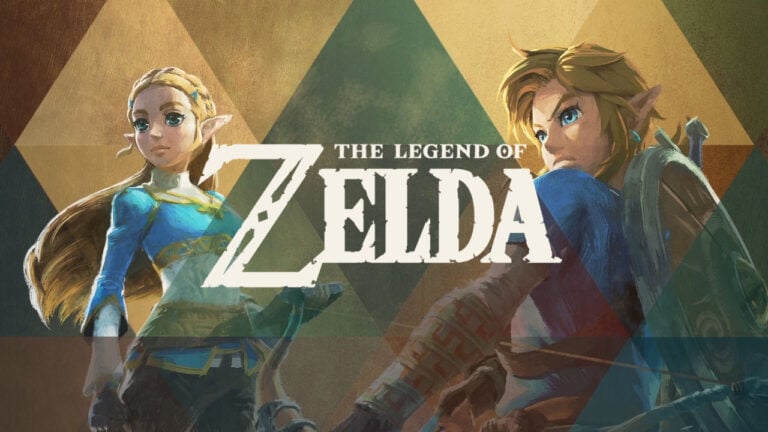
I\’m no stranger to inspiration, seeking it or feeling it. My childhood was one filled with notebooks, cardboard boxes, and long-winded narratives featuring various Hamtaro characters, and whatever else was in the plastic menagerie. There was always media in the background, some movie on repeat or Saturday morning cartoons. Being that I was the only child in my household fighting for the remote, there were also plenty of shows that went way over my head. For example, the Meredith and Derek romance of Grey\’s Anatomy had all my Barbies (and Kens) becoming surgeons with scalpels dripping of melodrama while watching Titanic for the first time meant my toys were constantly fighting for survival aboard a sinking ship. Play time wasn\’t about recreating the plot or relationships using toys, though, it was just that everything I consumed had to come out somewhere else – the same way that Taco Bell does. It\’s all shit in the end. I\’ve given my fair share of presentations throughout my life. The ones where I cite my sources, quote the authors I \”drew inspiration from,\” and every time it felt disingenuous. My work tethered, only in theory and not in practice, to another writer\’s, usually long dead, not even able to feel their ears burn as I spoke about them in front of my peers – the actual people inspiring and influencing my work. Did I really draw inspiration from Sylvia Plath? Sure, the same way every other depressed English undergrad did. But, Plath is Plath is Plath. No one else is Plath, no matter how hard they try. So, when I hear Wes Ball, the director of the new live action Zelda movie, say that he\’s \”drawing inspiration from Hayao Miyazaki\” I call bullshit. For long-time fans of both Ghibli and the Legend of Zelda series, a collaboration between the two studios felt just shy of a dream – there was potential, especially since Ghibli stories and Zelda stories tend to draw from a similar narrative well. Youth, curiousity, exploration, grief – parallels made even more obvious with the latest era of Zelda. But \”drawing inspiration from\” is not a replacement for the collaboration that could never happen. Emulation is an exercise taught frequently in writing programs. Read Walt Whitman and live in the grass leaves he lived in. This is a fine and dandy practice, and one that\’s beneficial to get professional writing jobs, where you can adapt to a brand\’s tone and style, but the purpose of emulation isn\’t to make it your own. It\’s to place a Legend on a pedestal and attempt to recreate their work without any of the tools, context, or experience. Ball\’s comments regarding Ghibli makes me think of this exercise in futility. He\’s playing a dangerous game with a pool of lifelong fans. As it stands, \”A Live Action Zelda Movie Inspired by Ghibli\” misses the point of both what makes Zelda, Zelda, and what makes Ghibli, Ghibli. What part of Ghibli is he drawing from? And what part of Zelda? Is it the weird, little characters? The subtlety of emotion? The soft backgrounds? Hunger-inducing food scenes? The ethereal nature of growing up? There\’s enough to be inspired by in a Ghibli film, but there\’s an equal treasure trove found already in the Zelda world. The considerable overlap aside, does Ball know what makes Zelda, Zelda or does he think Zelda and Ghibli are one in the same? Inspiration, to me, is a passive thing. It\’s the buzz of a mosquito in your ear while you\’re trying to relax in a hammock. It sweeps you when you\’re immersed in something else like a chill in a hot tub. It never comes when you\’re seeking a specific crumb. Every time I\’ve looked for inspiration, I\’ve come up empty-handed. Trying to consume something solely for inspiration turns it into shit. Many an outlet disagrees, keeping optimism alive in these trying times. Really though, Ball\’s nod to Ghibli sounds like a sad attempt at quelling the fear fans rightfully have that their beloved, whimsical gaming franchise will be rendered a CGI disaster with an ill-fitting, all-star cast a la Uncharted, or, dare I say, Sonic the Hedgehog? Why drag Ghibli into this? It\’s rich coming from a director who at one point (yes, it was in 2010, so it might not hold true), made comments that a Zelda movie should be a mo-capped blockbuster like James Cameron\’s Avatar. (Cameron is cited as yet another inspiration for him. As I\’m a fan of both Cameron and Miyazaki, I would suggest that a film trying to capture either oeuvre in one go have a billion dollar budget and a good production manager.) Ball has also called Zelda \”an untapped IP with so much potential.\” An untapped IP, not an inspiring 40-year Legend of a series with millions of worldwide fans in its own right. That\’s show business, baby. If the Legend of Zelda is just an untapped IP with so much potential, then it truly is sad to see that potential wasted on this upcoming film, where best business practices seem to be at the forefront more so than paying homage to a beloved video game legacy. And it\’s even sadder to see other beloved legacies drawn into the mire, touted as \”inspiration.\” Balls\’ dug his own grave with that sentiment, and I will be watching closely to see if he really can capture Miyazaki and Nintendo\’s work without the tools, context, wonder, and whimsy that truly inspired it. Or, if it will be exactly what I\’m expecting: shit.

The Legend of Zelda Live Action Movie Misses the Point of Zelda Read More »

scorsese

I Loved & Grew Up on Comicbook Movies & Martin Scorsese is Right

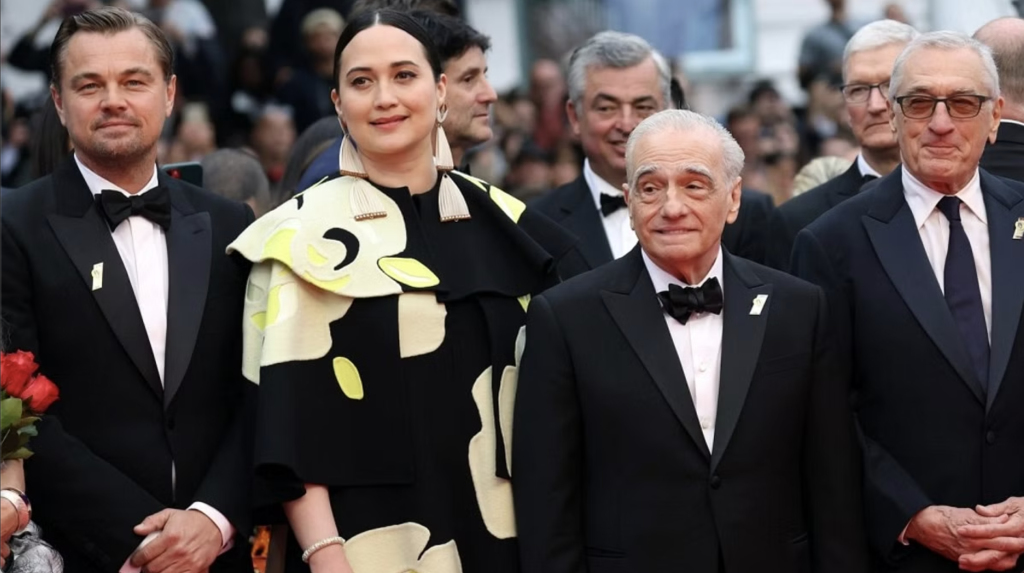
The discussion around Martin Scorsese\’s comments on comic book movies often misunderstands the director\’s intent. He advocates for more inclusion of non-comic book movies in theaters, not for the cessation of superhero films. His perspective differentiates between \”cinema\”, which he describes as a revelation-filled art form, and franchise pictures, which he sees as remakes catering to specific demands. Scorsese\’s concern lies in franchises taking over film exhibition, reducing opportunities for diverse movie-making on the big screen.

I Loved & Grew Up on Comicbook Movies & Martin Scorsese is Right Read More »